- January 31, 2026
- Posted by: Educational V.
- Categories: Financial Aid, Save Money
In 2026, the traditional college degree is only half of the equation. As AI reshapes the workforce, employers are no longer just looking at your GPA—they are looking for applied experience. An internship is no longer a “summer extra”; it is a 10-week-long job interview that can define your career trajectory. But what you might not know is that MANY college internships are PAID, putting money in your pocket that you can use to help pay for college! It’s truly a win-win! Whether you are aiming for a Fortune 500 powerhouse or a high-impact local startup, with this guide, you’ll discover how to find paid internships in 2026, even in today’s competitive job market.

Win more scholarships with less effort
Simplify and focus your application process with the one-stop platform for vetted scholarships.
Why Internships Are Key to Career Success
Internships are the most effective bridge from the classroom to a high-paying career. But given current economic challenges and and uncertain job market, it’s not easy to find paid internships in 2026. That’s why these success strategies are so important.
Direct Pipelines
Over 70% of interns at major firms receive full-time return offers.
Skill Validation
Internships prove you can handle professional tools (like AI-driven project management and remote collaboration) that aren’t always taught in school.
The Salary Bump
Students with two or more internships on their resume see an average 32% higher starting salary than those with none.
When Should Students Begin Their Internship Search?

Timing is everything. For Summer 2026 roles, the window opens sooner than you think:
High Finance, Tech, & Consulting
Recruitment sometimes begins as early as August for the following year; however, students are often successful at landing summer or fall internships as long as they prioritize searching for them in January / February of the current year. Which means that you should be searching for internships right now.
General Corporate & Creative
Peak search time is January through March for summer or fall internships.
The “Golden Rule”
Start your search at least 6–8 months before your intended start date.
How to Find Internship Opportunities
Don’t limit yourself to a single search bar when you are trying to find paid internships in 2026. Use a multi-channel approach to bypass the “AI filters” used by major sites.
Digital Platforms

Handshake
The #1 tool for college students; it connects your university directly with recruiters.
LinkedIn & Indeed
Great for volume, but use the “Posted in the last 24 hours” filter to stay ahead.
WayUp & Chegg Internships
Specialized platforms for early-career talent.
On-Campus Resources

Campus Career Center
Your college career center is staffed with a team whose entire job is to help you how to find paid internships in 2026! If you aren’t well-connected with your campus career center, you’ll missing out on services that can make or break your early career success.
Faculty Members
Your professors are industry experts who likely can suggest companies that have hired other students, whether for internships or regular positions. So become a frequent visitor during professor office hours, and take advantage of the networking relationships that your professors have built. Don’t wait for a professor to recommend you to a particular company. Ask for that recommendation and contact information so you can pursue those opportunities directly and start building your own network.
Alumni and Current Upperclassmen
Network with alumni and upperclassmen in your major. Ask them for recommendations for where you might find internships. Who knows? They might be able to connect you with one of their contacts to help ease your path from search to hire.
Major Employers Offering Paid Internships in 2026

If you are looking for high pay and structured mentorship, these “Gold Standard” employers lead the pack:
Technology and AI
Industry-leading pay + housing stipends.
Finance
The fastest path to a six-figure starting salary.
-
-
- J.P. Morgan
- Goldman Sachs
-
Engineering
Hands-on experience with cutting-edge hardware.
-
-
- Lockheed Martin
- SpaceX
- Tesla
- Boeing
-
Retail / Corporate
Diverse roles in marketing, supply chain, and HR.
-
-
- Target
- Walmart
- Proctor & Gamble
-
Finding Local Paid Internships: The “Hidden” Market

Not every great role is in Silicon Valley. Local internships offer lower competition and higher community impact.
Chamber of Commerce
Check your local directory for mid-sized firms that need fresh talent.
Municipal Government
Cities and counties hire paid interns for everything from data analysis to urban planning.
University Research Parks
Look for startups located near your campus for flexible, paid “Co-op” roles.
Strategies for Peaking Interest from Hiring Managers
In a sea of thousands of applicants, you need to stand out. Keep these strategies in mind when you are trying to find paid internships in 2026
The 24-Hour Rule
Apply to new postings within a day to be at the top of the recruiter’s inbox.
The Portfolio Link
Even for business roles, include a link to a “Featured” project on your LinkedIn or a Google Drive.
The “AI-Plus” Strategy
Use AI to help draft your resume, but manually add specific achievements that only a human could write.
Your Internship Search Toolkit

To win in 2026, your application cannot look like a template. You need a “digital identity” that proves you are ready for a professional environment. Here are the essential materials and the AI tools to help you build them.
The “Master” vs. “Targeted” Resume
The Master Resume
A 2-3 page document containing everything you’ve ever done. This is for your records.
The Targeted Resume (The One You Send)
A 1-page document tailored to the specific job description.
AI Boost
Use tools like Jobscan or Rezi to compare your resume to the job description. It will tell you exactly which keywords you are missing to pass the initial AI screen.
Dynamic Cover Letter
The era of the “Generic Cover Letter” is over. Every letter must answer: Why this company? and Why now?
AI Boost
Use Claude, Gemini, or ChatGPT to assist with the structure.
The Prompt Strategy
“Here is my resume and here is a job description for [Role]. Write a cover letter draft that connects my experience in [Specific Skill] to their need for [Specific Requirement]. Keep the tone professional but energetic.”
Pro Tip
Always edit the AI output! Recruiters are adept at spotting AI writing, so make sure you personalize and customize your cover letter.
Your LinkedIn Profile

In 2026, recruiters will Google you before they call you. Your LinkedIn is your landing page.
Profile Photo
Choose a professional-style head and shoulders portrait of yourself. Avoid selecting a “selfie-style” photo or a picture of yourself in cap and gown. If you don’t have a suitable photo to use, ask someone to take some photos of you and then select one that works for LinkedIn.
Headline
Don’t just put “Student.” Customize your headline, targeting what you are currently pursuing. Example: “Aspiring [Role] | [Major] at [University] | Specializing in [Skill 1] & [Skill 2].”
Featured Section
Upload PDFs of your best class projects or a link to your portfolio.
About Section
Write this in the first person. Tell a brief story about why you chose your field. Incorporate your skills and experience that are most relevant to the internships you are pursuing.
Education Section
Include all colleges / trade schools attended, especially if you have earned degrees or certificates from those programs.
-
-
-
-
- Your education should be listed in reverse chronological order, with your current college first, followed by previous colleges / trade schools. One exception to this: If you are currently enrolled in a certificate or associate degree program now, and have already earned a bachelor’s degree, you might want to list the bachelor’s degree first – the choice is yours.
- If you are a recent high school grad, you can also include your high school diploma as well as any special certificates / organizations you were involved in while in high school, especially if they are relevant to your college major.
-
-
-
Experience Section
Include all paid and unpaid work experience in this section, listing the most relevant work experience first, followed by unrelated work experience after. For example:
If you are a graphic design major, and interned at a marketing agency last year, but are currently a Barista at Starbucks, then you’ll want your marketing agency internship to be listed first, followed by Starbucks.
AI Tools to Supercharge Your Search
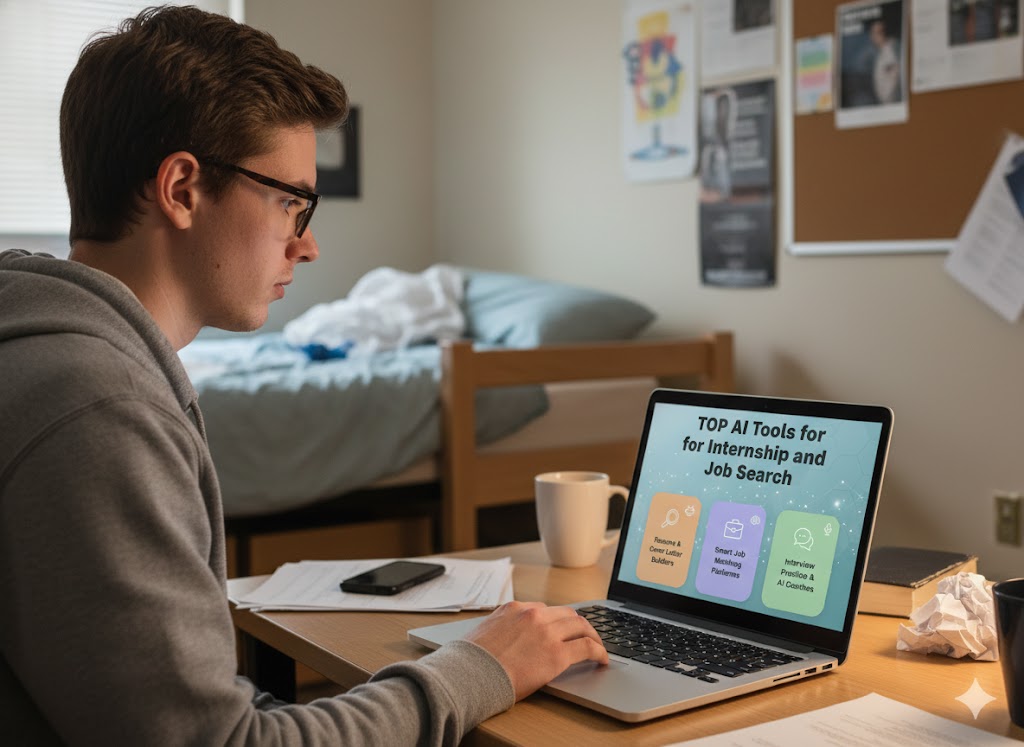
AI isn’t just for writing; it’s for search automation and market research. In fact, AI tools are key when you are trying to find paid internships in 2026
Perplexity AI
Use this for deep company research. Ask: “What are the biggest challenges [Company Name] is facing in 2026?” Use the answer to impress them in your cover letter.
Loop CV / Teal
These platforms help you track your applications, manage different versions of your resume, and even automate the submission process for certain roles.
Grammarly / Hemingway
Use these to ensure your tone is confident and free of the “passive voice” that often weakens student applications.
Checklist Before You Apply
-
-
-
- Resume: Is it 1 page? Do my employment dates match the dates of my work experience on my LinkedIn profile?
- Cover Letter: Did I customize my letter to align my skills with the job description?
- LinkedIn: Is my “Open to Work” status set for recruiters only?
- AI Check: Did I remove the “robotic” phrases from my AI-generated draft?
-
-
Interview Strategies for 2026
Virtual Interviews

Today, many hiring processes begin with one or more virtual interviews. Even though you may feel familiar with common tools and software used, it’s important to plan ahead for virtual interviews. Here are some key tips”
-
-
- Select a quiet, private location where you can participate in the interview. Avoid coffee shops and other public areas. If you’ll be in your bedroom, make sure you are in a room by yourself, and that your door is shut. If you are in a shared living space, ask your roommate(s) if they could plan on going somewhere else during the time of your interview.
- Plan what you’ll wear for the interview. Even though your interview(ers) will only see your head and shoulders, you should still appear professional from the waist up. Avoid t-shirts / shirts with screen print graphics on them.
- Use a neutral background, high-quality lighting, and look directly at the camera lens, not the screen.
- If possible, for better audio quality, use an external mic connected to your computer rather than your laptop’s integrated microphone.
- Download and install the latest desktop app of the software that will be used for the virtual interview well in advance of the interview (Zoom, Teams, Google Meet, etc.)
- Test your virtual setup with someone else in advance so you can make sure that all is running well. Schedule a meeting with that person through the software, and then both of you should login to the meeting.
- Look at your personal appearance as well as your environment as it appears on-camera. Determine if you’ll want to style your hair differently and/or apply makeup, etc.
- You may be surprised that your camera captures more of your living space than you had anticipated. If your space needs tidying up, do so prior to your interview.
- Make sure that your friend can hear you well during your practice meeting, and make sure that you can hear your friend as well. Adjust camera / mic / speaker settings as needed.
- On the day of your interview, login at least 10 minutes earlier than the agreed-upon start time. That way, you’ll ensure that you don’t have any technical issues that need to be addressed. Your interview host likely will login at the appointed time, which is fine. That gives you several minutes to breathe and get focused!
-
Mastering In-Person Interviews

In 2026, being invited to an “on-site” interview is a significant signal—it means you are likely in the top 3-5 candidates. At this stage, they know you have the skills; they are now checking for presence, soft skills, and culture fit.
Interview Attire
Dress codes have shifted, but “dressing up” for an interview still signals respect. Always dress one level above the daily office attire. If they wear t-shirts, you wear a polo or blouse. That said, recommended interview attire depends on the industry:
Finance/Law
Full business professional (Suit jacket/blazer with slacks; skirt/dress/slacks with blouse/blazer, etc.)
Tech/Creative
Business casual (Slacks and a polished shirt/sweater; perhaps a blazer without a tie).
What to Bring to Your In-Person Interview
Even in a paperless 2026, having physical materials shows a level of preparation that digital-only candidates lack.
Resume and Portfolio Materials
-
-
-
-
-
- Bring 3–5 high-quality printed copies of your resume.
- If you are applying for a creative role, plan on bringing a physical portfolio with high-quality prints of your best samples OR a laptop or tablet of your best samples. Avoid showing samples that are not your best work.
- If you are applying for a role that relates to research or writing, bring relevant examples of your writing or research.
- If applying for roles involving web development, programming, etc., then show your working prototypes or final projects on your laptop.
-
-
-
-
A Professional Notebook
Take manual notes. It shows you are actively listening and value the information they are sharing.
A “Cheat Sheet”
It’s okay to have a few pre-written questions in your notebook to refer to at the end. Only ask questions that haven’t been answered already during the course of the interview.
Interview Arrival Planning

The “First 5 Minutes” Rule
The interview begins the moment you step onto the company property, even before you walk in the door.
Lobby Etiquette
Be exceptionally polite to the security guard and receptionist. Recruiters often ask the front desk, “How did they act while waiting?”
Arrival Time
Arrive exactly 10 minutes early. Any earlier and you disrupt their schedule; any later and you’ve already failed the reliability test.
Body Language & Energy
In a world of Zoom fatigue, high-quality in-person energy is a competitive advantage.
The Handshake/Greeting
A firm handshake (or a professional nod depending on regional culture) and a genuine smile go a long way.
Posture
Sit upright and lean slightly forward to show engagement. Avoid crossing your arms, which can appear defensive.
Eye Contact
Maintain eye contact the best you can, even if you are nervous. It builds trust and shows confidence in your answers.
Interview Strategies

The “STAR+L” Method
Prepare for interview questions that align with the Situation, Task, Action, Result (STAR) method, and use the STAR + Learning (L) method when responding to those questions. What does this look like in practice? Describe a situation you were in, detailing your tasks / challenges, describe the actions you took, what the results were, and what you learned from the experience.
Ask Smart Questions
Ask questions that show you’ve already done your homework about the company and the role you’re pursuing. Questions where answers could easily be found on the company website should be avoided.
Also – avoid asking about compensation, benefits, time off, etc. These kinds of questions are premature in an interview setting when you are applying for internship opportunities. The interviewer might feel that you are more interested in what you’ll gain financially from the opportunity rather than what you’ll learn, and what you’ll contribute to the company. Should you be offered the role, you can discuss pay and benefits at that time, if the internship is designated as a paid opportunity.
Conclusion

When you are trying to how to find paid internships in 2026, you’ll need to leverage a mix of early timing, strategic networking, and a results-driven resume. By targeting both major national employers and local gems, you maximize your chances of success. And before you know it, you’ll not only have landed an internship; you’ll also be primed and ready to apply for paid positions in your field as you approach college graduation.
Ready to fund your education while you build your career? Start your free 7-day trial at www.ScholarshipOwl.com to find scholarships to cover college costs so you can focus on preparing for your dream career!