- July 27, 2026
- Posted by: Educational V.
- Categories: Save Money, Scholarships
The narrative of the American student often centers on academic ambition, but for Gen Z, the central tension continues to be economic survival. As inflation persists and tuition rises, understanding how students afford college has become a critical question for millions of families. Facing escalating costs for everything from housing to daily groceries, students are forced to adapt rapidly to keep their educational goals within reach.

In June 2026, ScholarshipOwl surveyed 27,984 high school and college students—nearly double the sample size of our November 2025 study—to measure changes in the financial hardship facing the rising generation. Because this survey reused the exact questions from our November 2025 benchmark, the data offers a clear, side-by-side view of shifting trends over the past seven months.
The overall takeaway? Financial pressure on Gen Z has intensified across nearly every metric. Yet, despite worsening economic conditions, students are not backing down. Instead, they are adapting—balancing work, side hustles, aid strategies, and conscious spending to protect their educational dreams.
Who Participated in the Survey?
In June 2026, 27,984 high school and college students on the ScholarshipOwl platform shared their financial realities:
-
Gender Identity: 62% female, 36% male, and 2% identified as another gender identity or preferred not to answer.
-
Racial & Ethnic Diversity: 43% Caucasian, 26% African-American, 17% Hispanic/Latino, 6% Asian/Pacific Islander, 2% American Indian/Native American, and 6% selected “other” or preferred not to answer.
-
Academic Level: 39% high school students (led by high school seniors at 31%), 45% college undergraduates (led by 1st-year students at 21%), 11% graduate students, and 6% adult/non-traditional students.
What the Demographic Shifts Tell Us: Macro Trends vs. Seasonal Mechanics
Comparing our June 2026 respondent pool to our November 2025 study reveals two notable demographic shifts: a higher proportion of African-American participants (26%, up from 18%) and a higher concentration of students further along in their postsecondary journeys (45% undergraduates and 11% graduate students, compared to 28% and 5% previously).
While part of this shift is seasonal—high school seniors dominate fall scholarship activity as they apply to college, whereas enrolled undergraduates face immediate mid-year tuition bills—these trends also mirror broader changes across higher education:
Shifting Enrollment Patterns & Targeted Need
National studies show that higher education is diversifying, even as traditional college pathways undergo realignment. At the same time, students facing the largest financial gaps—historically including minority and first-generation college students—are actively seeking debt-free aid at higher rates to keep pace with inflation.
The Rise of the Post-Traditional Student
According to the Postsecondary National Policy Institute (PNPI), nearly three-quarters of all U.S. undergraduates display at least one non-traditional characteristic (e.g., age 24+, working full-time, or financially independent). As higher education adapts to an older, working-student population, platforms providing access to aid are serving students far beyond the standard high-school-to-college pipeline.
Comparative Data: Nov 2025 vs. June 2026
Overall Financial Outlook
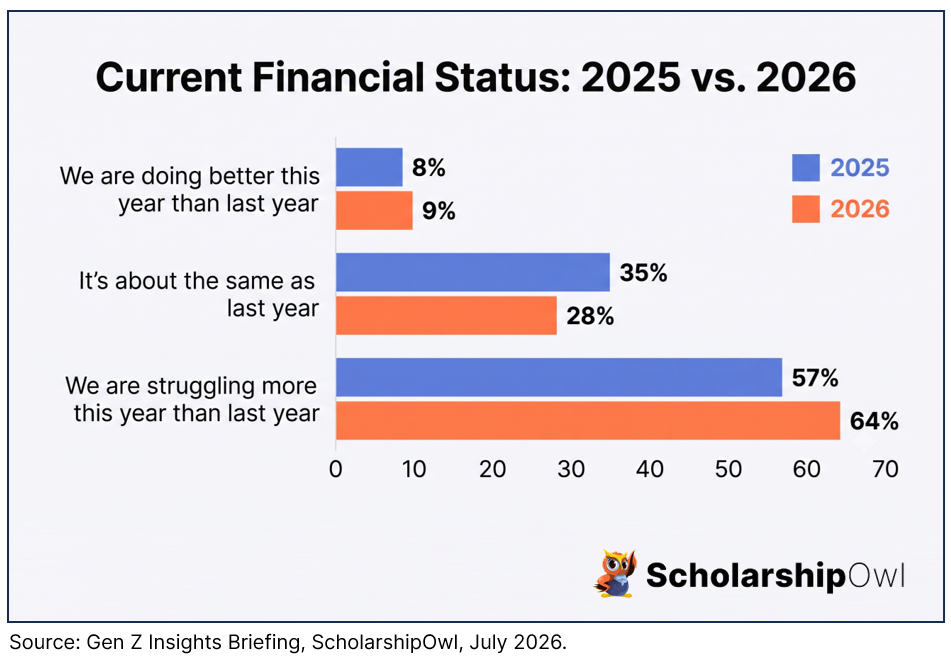
For our first survey question, we asked respondents, “In thinking about how things are going financially for yourself and your family, which statement best describes your financial situation?”
Win more scholarships with less effort
Simplify and focus your application process with the one-stop platform for vetted scholarships.
More than two-thirds (64%) said that they are struggling more than last year, which is a 7% increase over our November 2025 data. Alongside that, just 28% of respondents assessed their financial position as about the same as last year, which was a 7% decrease from the November data. And only 9% of respondents said they are doing better this year than last year, a slim 1% increase over last year’s data.
Adverse Financial Impacts
Our next survey question asked, “Which of the following has adversely impacted you OR your immediate family?” Respondents were told to select all that applied to their situation.
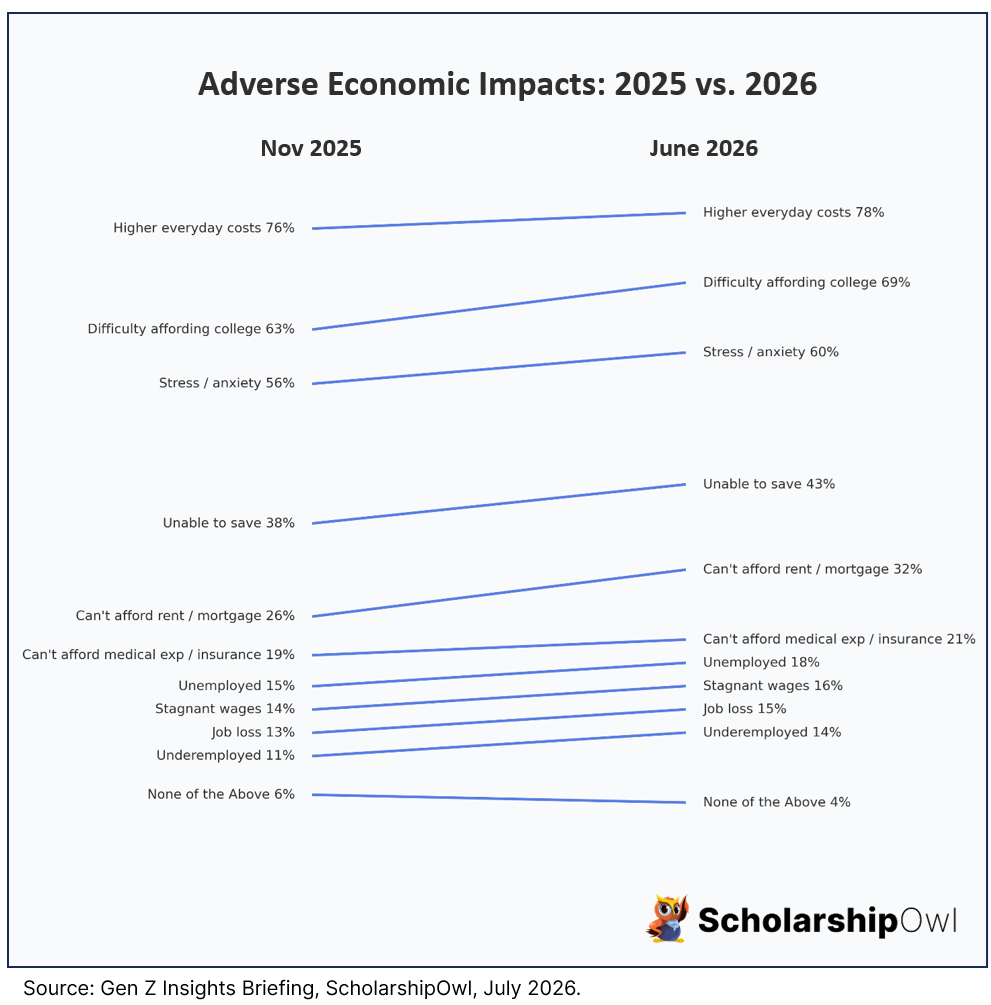
Across the board, responses indicated increases in adverse economic impacts when comparing our June 2026 data to our November 2025 survey. In fact, the only response that decreased was “none of the above,” which demonstrates the just how much students and their families are struggling to make ends meet.
-
-
-
- Higher everyday costs: 78% (+2% change)
- Difficulty affording college: 69% (+6% change)
- Financial stress / anxiety: 60% (+4% change)
- Unable to save / living paycheck to paycheck: 43% (+5% change)
- Difficulty affording rent / mortgage: 32% (+6% change)
- Difficulty affording medical expenses / health insurance: 21% (+2% change)
- Unemployed and struggling to find a job: (18% (+3% change)
- Stagnant wages: 16% (+2% change)
- Job loss: 15% (+2% change)
- Underemployed: 14% (+3% change)
- None of the above: 4% (-2% change)
-
-
Mitigation Strategies & Action Steps
For our final question, we asked respondents, “What steps are you taking or have you taken to help mitigate financial challenges?” Students were able to select all that applied to them.
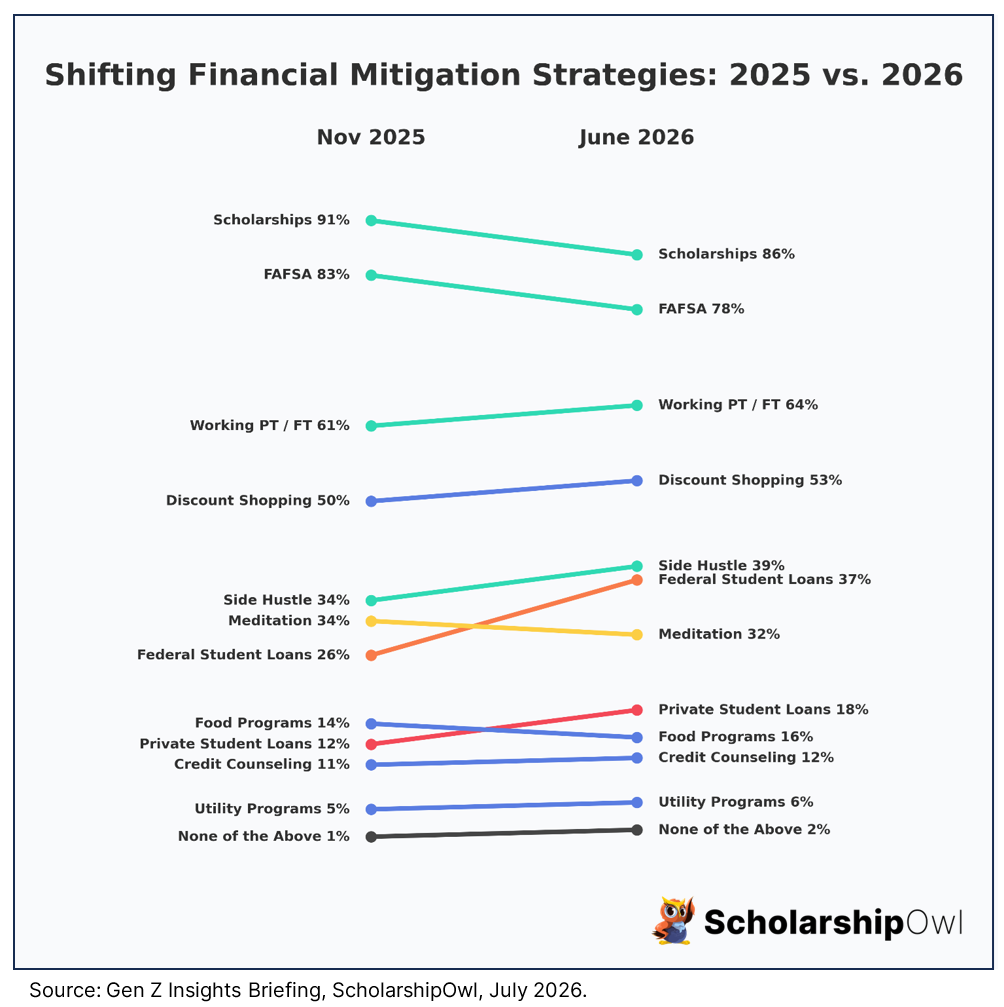
The results here were a bit surprising, with a 5% decrease in the percent of students prioritizing scholarships and the Free Application for Federal Student Aid (FAFSA), alongside a significant increase (11%) in the percent of students who are relying on federal student loans, and a 6% increase in students taking out private student loans. On the more positive side, students are increasing their income through employment and side hustles, while also seeking out opportunities to decrease their expenses.
-
-
-
- Prioritizing scholarship applications: 86% (-5% change)
- Submitting the FAFSA: 78% (-5% change)
- Working part-time or full-time: 64% (+3% change)
- Buying groceries at discount stores: 53% (+3% change)
- Taking on a side hustle: 39% (+5% change)
- Taking out federal student loans: 37% (+11% change)
- Practicing meditation / mindfulness for stress: 32% (-2% change)
- Taking out private student loans: 18% (+6% change)
- Participating in food assistance programs: 16% (+2% change)
- Accessing credit counseling services: 12% (+1% change)
- Participating in utility assistance programs: 6% (+1% change)
- None of the above: 2% (+1% change)
-
-
Key Takeaways
Financial Strain is Rapidly Deepening
The most striking finding from the June 2026 survey is that financial degradation is accelerating. Nearly 2 in 3 students (64%) now report that their families are struggling more this year than last year—a significant 7-point increase since November 2025.
Daily cost-of-living increases remain the primary trigger, with 78% impacted by higher grocery and everyday costs. Furthermore, housing strain and savings depletion jumped sharply:
Educational Affordability Has Reached a Tipping Point
In late 2025, 63% of students cited difficulty affording college. By June 2026, that number climbed to 69%. Higher tuition fees, combined with reduced household disposable income, mean that paying for higher education is no longer just a hurdle—it is an active crisis for over two-thirds of students.
Students Are Turning to Debt as Emergency Capital
Perhaps the most concerning shift between 2025 and 2026 is the surge in student loan reliance:
While Gen Z has historically demonstrated a strong desire to avoid debt, escalating costs are forcing many to accept loans simply to keep their seats in the classroom.
Working and Hustling Are Becoming the Baseline
Students are working harder than ever to cover the deficit. 64% now work part- or full-time jobs while pursuing their education, and 39% maintain side hustles (up from 34%). While this hustle mentality demonstrates inspiring independence, it also poses a real risk of academic burnout and exhaustion.
Free Aid Remains Critical, But FAFSA Hurdles Persist
Debt-free money remains top-of-mind, with 86% of students actively prioritizing scholarships. However, scholarship prioritization (-5%) and FAFSA submissions (-5%) both experienced minor dips compared to late 2025. This downward shift may reflect some students feeling overwhelmed, leading them to choose loans as an easy short-term solution for their funding needs. However, when students accept loans, they are actually accepting debt that they will have to repay with interest.
Mental Health and Safety Nets Under Pressure
Financial strain continues to directly impact wellness. 60% of students now report anxiety and stress stemming from their financial situation (up from 56%). Additionally, reliance on community and government support systems continues to grow: 16% turn to food assistance programs (SNAP, food pantries) and 6% utilize utility assistance to keep up with basic survival needs.
Strategic Action in the Face of Escalating Pressure
The comparative data between November 2025 and June 2026 delivers an unmistakable message: Gen Z is operating under unprecedented financial stress. Cost-of-living spikes and tuition inflation are narrowing the margin for error, forcing students to work longer hours and rely more heavily on loans than they did just seven months ago.
Yet, despite these challenges, Gen Z remains remarkably resilient and resourceful. They are actively budgeting, working, seeking community support, and looking for debt-free funding alternatives wherever possible.
Because debt-free aid is the ultimate barrier against loan reliance, access to streamlined, debt-free support isn’t just helpful anymore—it’s essential. Navigating college expenses requires a proactive strategy that puts non-repayable aid at the forefront.
Take Control of Your Financial Future
Don’t let rising costs disrupt your education or lock you into unnecessary debt. Join the thousands of proactive students using ScholarshipOwl to find, match, and apply for verified scholarships in minutes. Sign up for your ScholarshipOwl free 7-day trial today and start securing your debt-free future!
For Further Reading