- June 9, 2026
- Posted by: Educational V.
- Categories: Grants, Save Money, Scholarships

For Gen Z, the conversation around a college degree is shifting from “Where am I going for college?” to a much more practical question: “How will I manage paying for college without ruining my financial future?”

As tuition costs continue to climb, students are developing strategies to navigate financial aid offers, prioritize private scholarships, and weigh the long-term burden of student debt against the value of a college education. To get a clearer picture of how the upcoming academic year will impact a student’s bottom line, ScholarshipOwl surveyed over 21,000 high school and college students in May 2026 to find out more about how they are paying for college.

The results reveal a generation that wants debt-free funding, yet still finds itself entangled in the reality of student loans.
Who Participated in the Survey?
In May 2026, ScholarshipOwl surveyed 21,255 high school and college students on the ScholarshipOwl scholarship platform to find out more about how Gen Z students will be paying for college in the 2026-27 school year.
Among the respondents, 62% were female, 36% were male, and 2% identified themselves as a different gender identity or preferred not to respond to the question. Almost half (45%) were Caucasian, 24% were Black, 18% were Hispanic/Latino, 6% were Asian/Pacific Islander, 2% were American Indian/Native American and 6% selected “other” or preferred not to respond to the question.
Nearly half (45%) of the respondents were high school students, with the overwhelming majority high school seniors; more than one-third (39%) were college undergraduate students, primarily college freshmen and college sophomores; 11% were graduate students and 6% identified themselves as adult/non-traditional students.
Financial Aid and Scholarships
Respondents were asked to indicate the types of financial assistance they were awarded in their financial aid offer through the Free Application for Federal Student Aid (FAFSA) and/or through external scholarships for the 2026-27 school year. Respondents were told to select all that apply.
Amongst the 14,696 respondents who had received their financial aid offer and will be in college in 2026-27, most selected more than one response.
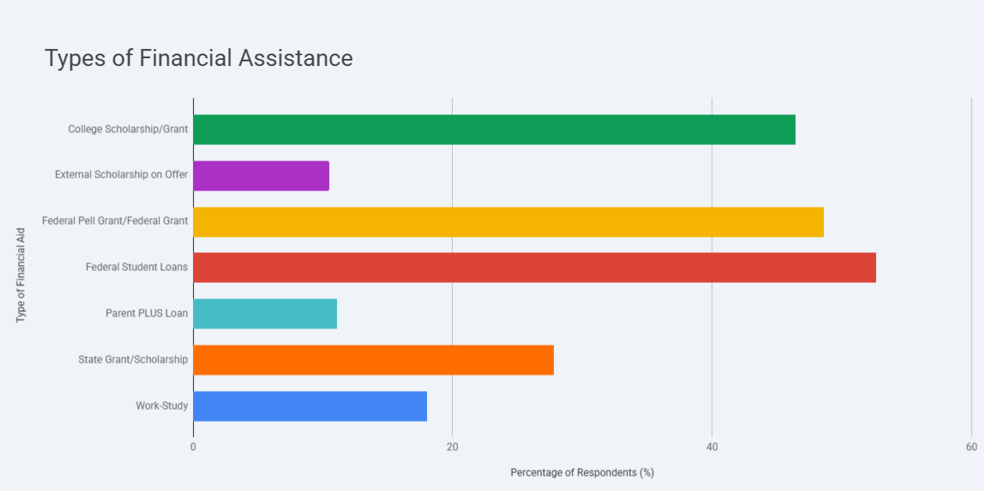
Many were offered debt-free sources of funds to help them pay for college:
- Federal grant: 49%
- State grant: 28%
- Institutional scholarship(s): 46%
- External scholarship(s) through ScholarshipOwl, other scholarship websites and/or local organizations in their community: 25%
- Federal Work-Study: 18%
A majority of students were also offered loans to help cover their out-of-pocket costs:
- Federal student loans: 53%
- Parent PLUS Loan: 11%
Anticipated Reliance on Loans
Students were asked to indicate which type(s) of loans they or their family plan to take out to cover their college costs, either in the 2026-27 school year OR a future year. Respondents were asked to select all that apply.
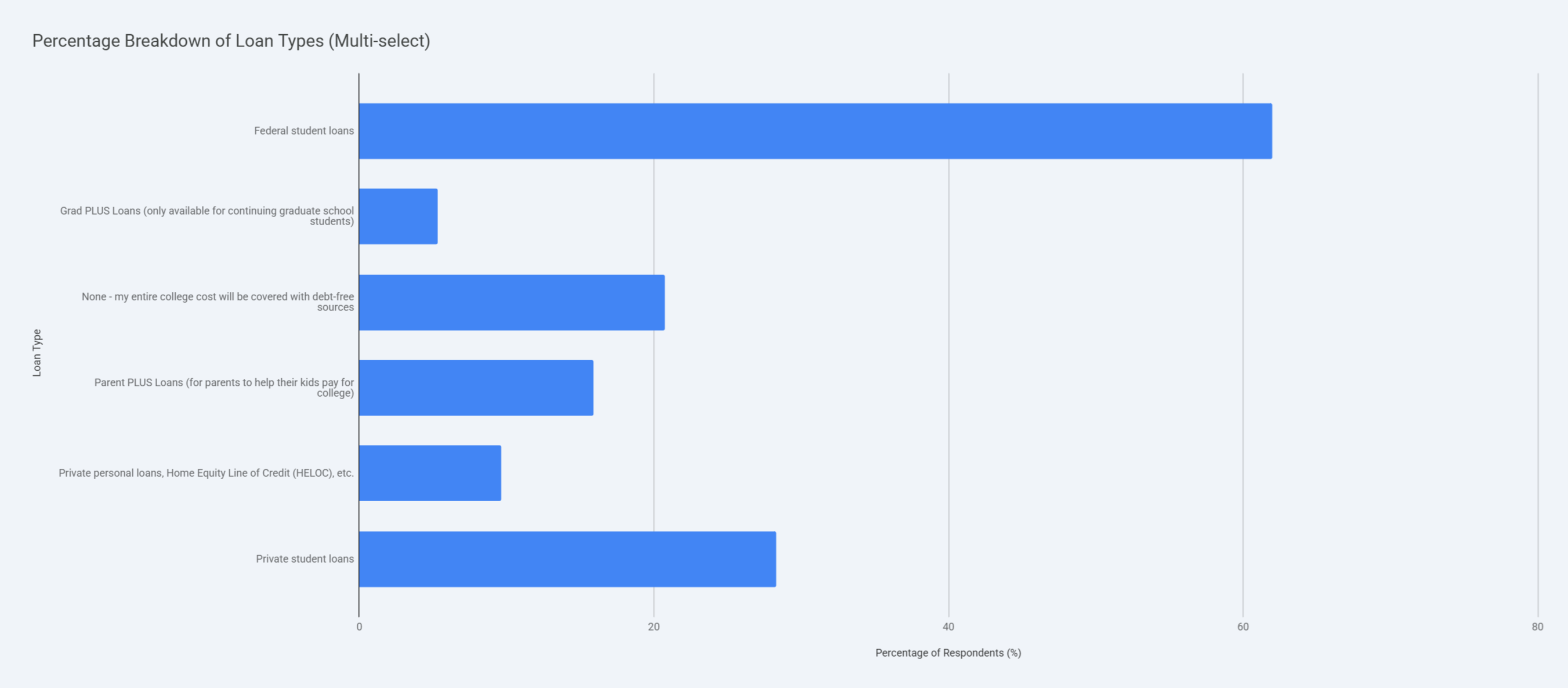
- Federal student loans: 62%
- Private student loans: 28%
- Grad PLUS Loans (only available for continuing graduate students): 5%
- Parent PLUS Loans: 16%
- Private personal loans: 10%
- None – my entire college cost will be covered with debt-free sources: 21%
Impact of Student Debt on College Plans
We wondered whether the prospect of having student debt might change a student’s perspective on attending college. We asked, “If you knew that the ONLY way you could afford a university was to take out student loans, how would that impact your college plans?” Students were asked to select the one answer that fit them best.
Win more scholarships with less effort
Simplify and focus your application process with the one-stop platform for vetted scholarships.
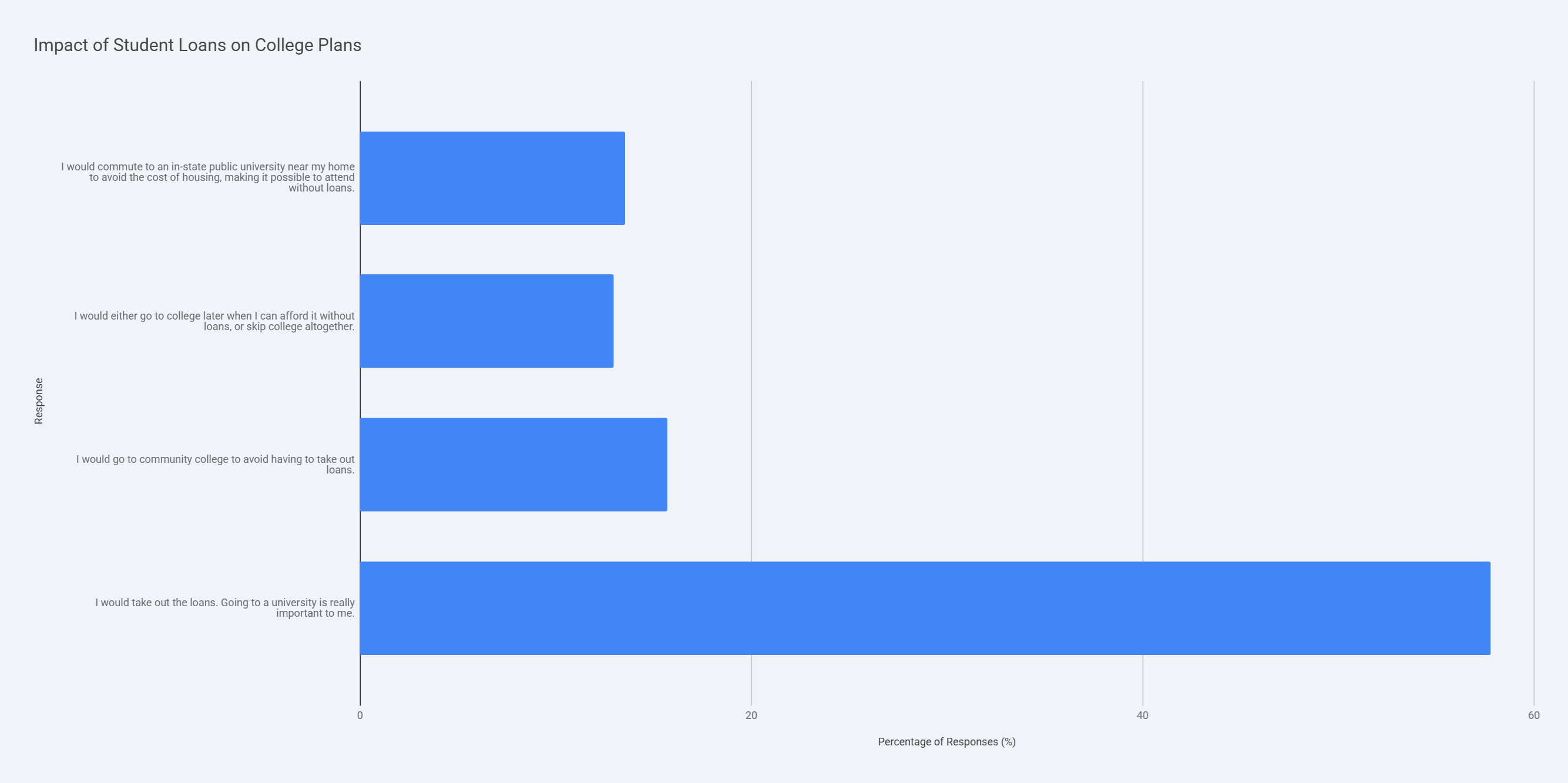
- I would take out the loans. Going to a university is really important to me: 58%
- I would go to community college to avoid having to take out loans: 16%
- I would commute to an in-state public university near my home to avoid the cost of housing, making it possible to attend without loans: 14%
- I would either go to college later when I can afford it without loans, or skip college altogether: 13%
Key Takeaways

An analysis of the survey data reveals three major trends related to paying for college:
The “Funding Gap” is Forcing Most Students Into Debt
The data shows that debt-free funding sources are offered to many students, with nearly half of the respondents securing federal grants (49%) and/or institutional aid (46%). However, that funding leaves significant gaps, leading colleges to include student loans as an option for more than half (53%) of the respondents.
When looking at future projections, that reliance on debt spikes even higher, with nearly two-thirds (62%) of students anticipating they will need federal student loans at some point during their degree. Worse, more than one-quarter (28%) expect to turn to higher-interest private student loans. Just a slim minority (21%) of students expect to graduate entirely debt-free. This highlights a persistent “funding gap” where traditional grants and university scholarships simply aren’t keeping up with the total cost of attendance.
Private Scholarships Remain a Critical, Underutilized Lifeline
While 46% of students unlocked institutional scholarships directly from their colleges, only 25% secured external scholarships through platforms like ScholarshipOwl or local organizations. Yet every year, $8.2 billion dollars are available in external private scholarships from business, nonprofit organizations, and foundations. This is in addition to funds available from federal, state, and institutional sources.
Because institutional aid is most-often awarded by private colleges as a recruitment enticement during a student’s senior year of high school, external scholarships present an on-going alternative to loan debt – yet far too many students fail to leverage that opportunity. In fact, according to the 2025 How America Pays for College report from Sallie Mae, 40% of undergraduates did not receive institutional or external scholarships at all in 2024-25. But that’s only part of the story, because of those 40%, a whopping 70% didn’t even apply for scholarships at all! Of course, if you don’t apply, you won’t receive.
Given this, there is extensive opportunity for students to ramp up their applications and proactively lower their eventual debt load by earning scholarships.
Most Students Would Turn to Loans If Needed
Perhaps the most telling data point is how students react to the prospect paying for college with forced debt. When asked what they would do if loans were the only way to afford a university, more than one-third (42%) of students would actively alter their life plans to avoid debt. Specifically:
-
-
-
30% would choose community college (16%) or commuting to a local in-state public university (14%) to eliminate housing costs.
-
13% would delay or entirely skip higher education.
-
-
This demonstrates that many Gen Z students are saying “no” to student debt. However, the fact remains that nearly two-thirds (58%) would prefer to take out loans rather than pass-up an opportunity to enroll at the university of their choice.
For today’s students facing a challenging economy with low-hire, low-fire tendencies and AI encroaching on early-career jobs, the choice is complex and anxiety-provoking. And unfortunately, there are no easy answers.
Strategies to Avoid Student Loans
If you are part of the 42% of students determined to avoid debt, or if you simply want to shrink that 62% chance of needing a loan, you need a proactive game plan for paying for college. Relying solely on your school’s financial aid package simply isn’t enough.
Here is how you can rewrite the college playbook and fund your education debt-free:
Leverage Community College as Your First Step

One of the fastest ways to slash your tuition bill in half is to spend your first two years at a local community college completing your general education requirements. Ensure your credits are part of a statewide articulation agreement for smoother credit transfer, and then transition to a university for two years to graduate with your bachelor’s degree. You’ll get the same degree for a fraction of the cost of all four years at a university!
Hack Your Housing Costs
As the survey showed, 14% of students plan to commute to save money. But if living at home isn’t an option, look into becoming a Resident Advisor (RA) on campus after your freshman year. Most universities cover 100% of room and board for RAs, eliminating what is often the second-largest expense on a college bill.
Maximize Federal Work-Study and Campus Jobs
Only 18% of students in our survey were offered Federal Work-Study, but even if you weren’t, most campus departments (libraries, recreational centers, dining halls) hire regular student workers too. These jobs are uniquely tailored to student life, often allowing you to study during downtime and giving you a direct paycheck to cover textbooks and living expenses. Paying for college with income instead of loans is certainly a smarter strategy.
Treat Applying for Private Scholarships Like a Part-Time Job
Paying for college with private scholarships is a great way to cover the leftover “gap” between your financial aid offer and your actual tuition bill. Because only 25% of surveyed students managed to secure external scholarships, the field is wide open for students who are consistent. If you spend just a few hours a week applying, winning even a couple of $1,000 awards vastly outperforms the hourly wage of a typical teenage part-time job.
Supercharge Your Scholarship Efforts with ScholarshipOwl

One of the most frustrating aspects of applying for scholarships is simply finding the right ones to apply for. If you’ve spent time Googling for scholarships, you know what that experience is like – it’s painstaking, time-consuming, and frustrating. That’s why millions of students have turned to ScholarshipOwl.
The ScholarshipOwl platform offers significant strategic advantages:
AI-Powered Recommendations & Smart Matching Technology
Every week, you’ll find three recommended scholarships in your dashboard, tailored just for you, based on your profile. Our Recommendation System is AI-Powered, so over time, your recommended scholarships will be more and more relevant to you.
You’ll also find tons of other scholarships you’re matched to in the Matches tab. So instead of scrolling through pages and pages of Google search results, you’ll only see scholarships that align with your specific background, major, career goals, and more.
Frustrated when you stumble across a scholarship on Google that you’re excited about, only to discover that the scholarship has expired? That won’t happen to you in the ScholarshipOwl platform, because expired scholarships are automatically removed from your match list. And what’s more, new scholarships are added to our database all the time, so you’ll always see new matches every time you login!
Never Complete Application Forms
That’s right. No application forms. Ever. Why? Because when you complete your profile in the ScholarshipOwl platform, your profile serves as a universal application for all the scholarships in your match list! Just this one advantage is a game-changer, streamlining your process so you can apply to more scholarships in a shorter amount of time.
Access Easy-Apply Scholarships to Amplify Your Efforts
We know that students love scholarships that require minimal time and effort. You’ll find plenty of these opportunities on the ScholarshipOwl platform. But what you might not know is that we give you lots of different ways to apply for them!
-
-
-
-
-
-
- Automatic Applications: Let us apply you for all of the “no requirement” scholarships on your match list. Just opt-in to automatic applications.
- Automatic Reapplications for Recurring Scholarships: Did you know that many scholarships select winners multiple times each year? If you opt-in to automatic reapplications, we will automatically re-apply you for these scholarships after you’ve applied the first time.
- Apply By Email: One of our latest innovations is the ability to apply to certain scholarships simply by replying to an email, even if you aren’t logged in to the platform.
-
-
-
-
-
Specialized Insights You Won’t Get Anywhere Else
Anyone who has ever scrolled through hundreds – or thousands – of scholarships knows the one question that all scholarship hunters want to know: “Which scholarships will be most worth my time and effort?” The ScholarshipOwl platform makes it easy by giving you access to sort and filter tools that help you answer the question yourself:
-
-
-
-
-
-
- Focus on lower-competition scholarships by applying for scholarships with fewer applicants. Our “Number of Applicants” filter shows you exactly how many students have applied to each scholarship in our platform in real-time.
- Access our Credibility Scores to prioritize scholarships offered by vetted providers and avoid scholarship scams.
- Track and monitor your application status right in the platform. No need to create and manage a spreadsheet!
-
-
-
-
-
Access Our AI Essay Assistant
Essay scholarships are an outstanding funding resource, but far too many students skip them due to the time and effort involved. But thanks to our AI Essay Assistant, you can leverage technology to help you draft your application essays faster! While there are AI technologies that can help you write outside our platform, none of them work as well as ours when you are applying to scholarships with ScholarshipOwl. That’s because when you use it, our system will ask you questions to help get you started on your essay, and thost questions will be related to the essay prompt. On top of that, the more you use the ScholarshipOwl platform to apply for scholarships, the more and more relevant your AI-assisted essays will be to you and your own personal background, experience, and interests. So over time, you’ll find it even faster and easier to apply for essay scholarships.
By leveraging the power of our technology to help you with your scholarship process, you’ll find you can apply to a much higher volume of right-fit scholarships in a fraction of the time, dramatically increasing your odds of a debt-free graduation.
The New College Playbook

The May 2026 survey numbers paint a clear picture: Gen Z students deeply value the power of a college education, but they are hyper-aware of the financial shadow that student loans can cast over their financial future. Higher education is no longer just about finding the “perfect school.” It’s about finding the most affordable path to college and career.
For the 58% of students willing to take on debt, and the 42% looking for alternative routes, the mandate is the same when paying for college: maximize debt-free funding at every turn.
Relying solely on a university’s financial aid package is rarely enough to cover the total cost of attendance. To minimize the need for federal and private loans, students must treat external scholarship hunting not as a seasonal task, but as a year-round strategy. They must also work part-time during the school year and full-time during breaks and use their earnings to pay for their education. This combination of prioritizing scholarships and income from a job will enable students to minimize their reliance on loans to pay for college – and perhaps enable them to avoid taking on any loans at all.
Further Reading
ScholarshipOwl conducts Gen Z research on timely and critical topics. Checkout some of our recent surveys: